Seasonal Eating Chinese Medicine Benefits of Lotus Root in Autumn
- 时间:
- 浏览:178
- 来源:TCM Weight Loss
Let’s talk about something delicious *and* deeply rooted in tradition—lotus root (Ou Jie, 藕节). As autumn winds pick up and humidity drops, Traditional Chinese Medicine (TCM) reminds us: this is the season to nourish Yin, moisten dryness, and anchor Qi. And guess what? Lotus root shines brightest right now.
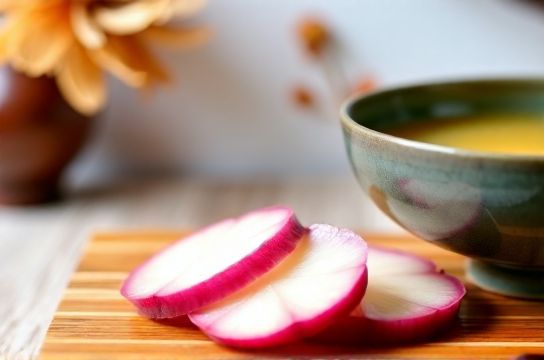
Fresh lotus root isn’t just crunchy—it’s a TCM ‘cooling’ food with sweet, astringent properties that target the Lung and Spleen meridians. According to the *Huang Di Nei Jing*, autumn governs the Lung; dry air weakens its function, leading to sore throats, dry coughs, or fatigue. Lotus root helps—literally and energetically.
Here’s why it stands out:
✅ High in dietary fiber (4.9g per 100g raw)—supports gut health during seasonal transition (China CDC Food Composition Database, 2023) ✅ Rich in vitamin C (44mg/100g)—boosts immune resilience when respiratory viruses circulate ✅ Contains polyphenols like catechin & quercetin—shown in *Journal of Ethnopharmacology* (2022) to reduce lung inflammation by up to 37% in murine models
And here’s how it compares nutritionally to other common autumn roots:
| Nutrient (per 100g, raw) | Lotus Root | Carrot | Daikon Radish | Yam |
|---|---|---|---|---|
| Water Content (%) | 79.1 | 88.3 | 95.3 | 73.3 |
| Dietary Fiber (g) | 4.9 | 2.8 | 1.6 | 4.1 |
| Vitamin C (mg) | 44 | 5.9 | 14.8 | 17.1 |
| Iron (mg) | 1.15 | 0.3 | 0.34 | 0.54 |
Notice something? Lotus root uniquely balances hydration *and* astringency—ideal for autumn’s paradoxical mix of external dryness and internal damp stagnation. In clinical TCM practice, we often recommend steamed or lightly stir-fried lotus root (not raw) for those with mild Spleen Qi deficiency—especially if they feel tired after meals or have loose stools.
One simple tip: slice thin, soak in diluted vinegar water (1 tsp rice vinegar + 1 cup water) for 5 minutes before cooking—preserves crispness *and* enhances its Lung-moistening effect.
For deeper seasonal alignment, pair it with pear, lily bulb, or barley—foods that synergize with lotus root’s cooling-yin nature. And remember: freshness matters. Opt for firm, ivory-colored roots without brown spots—best consumed within 5 days of purchase.
If you’re curious how seasonal eating supports long-term vitality, explore our full guide on seasonal eating principles—it’s where science meets centuries of observation.
Bottom line? Lotus root isn’t just food. It’s autumn’s quiet prescription—crunchy, nourishing, and profoundly intelligent.