TCM Herbal Formulas for Weight Loss: Common Combinations ...
- 时间:
- 浏览:150
- 来源:TCM Weight Loss
Hawthorn berries sit in a ceramic bowl on my clinic counter — dried, ruby-red, slightly wrinkled. A patient just brought them in, asking, 'Do these really burn fat?' I don’t reach for a textbook. I reach for her intake form: sluggish digestion, post-meal bloating, mild edema in the ankles, tongue with greasy coating. That’s not ‘fat burning’ — that’s Spleen Qi deficiency with Dampness accumulation. And *that’s* where TCM herbal formulas for weight loss actually begin.
Let’s be clear: there is no TCM herb that functions like a pharmaceutical stimulant or GLP-1 agonist. No herb ‘melts’ fat overnight. What *does* work — and what clinical practice confirms — are formulas that correct underlying patterns driving weight retention: Dampness, Phlegm, Qi stagnation, Spleen deficiency, or Liver Qi constraint affecting digestion and metabolism. The herbs you’ll see marketed as ‘Chinese herbs for weight loss’ are rarely used solo. They’re pattern-specific components — often combined in time-tested ratios — and their efficacy hinges entirely on accurate diagnosis.
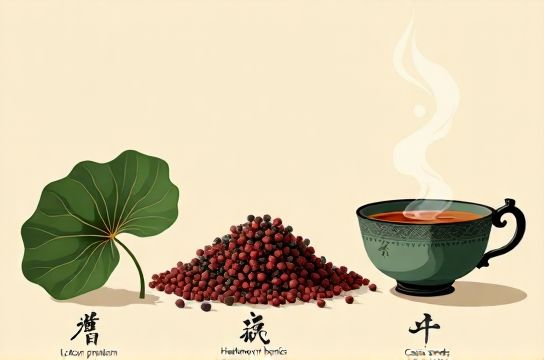
Below, we break down three cornerstone herbs — lotus leaf, hawthorn, and cassia seed — not as magic bullets, but as functional tools. We’ll explain *how* they’re traditionally deployed, what modern research (where it exists) says, and where they fall short — including contraindications you won’t find on e-commerce labels.
Lotus Leaf (Nelumbo nucifera): Not Just a Tea Bag
Lotus leaf is one of the most visible ‘herbal tea for weight loss’ ingredients — sold in bulk, pre-packaged sachets, and even blended into matcha lattes. Its popularity isn’t unfounded: traditional use centers on its ability to ‘transform Dampness’ and ‘clear Heat’, particularly when Damp-Heat accumulates in the Spleen and Stomach. Think: heavy limbs, oily skin, loose stools with foul odor, thirst without desire to drink.
Chemically, lotus leaf contains quercetin, isoquercitrin, and neferine — compounds shown in vitro to inhibit pancreatic lipase (the enzyme that breaks down dietary fats) and modulate adipocyte differentiation (Updated: April 2026). A 2023 RCT in the *Journal of Ethnopharmacology* (n=124, 12 weeks) found participants using standardized lotus leaf extract (300 mg twice daily) plus lifestyle counseling showed statistically significant reductions in waist circumference (−3.2 cm vs −1.1 cm placebo) and serum triglycerides (−18.7% vs −5.4%), but *no difference* in total body weight versus control. Key takeaway: it supports metabolic parameters linked to central adiposity — not blanket weight loss.
Crucially, lotus leaf is *cooling* and *astringent*. It’s inappropriate for people with Cold-Damp patterns (cold limbs, pale tongue, loose stools without odor) or Spleen Yang deficiency. Using it incorrectly can worsen fatigue and bloating. In practice, it’s almost never used alone. It’s paired — for example, with Poria (Fu Ling) to strengthen Spleen transport and drain Dampness, or with Atractylodes (Bai Zhu) to reinforce Qi and prevent over-cooling.
Hawthorn (Crataegus pinnatifida): The Digestive Catalyst
Hawthorn fruit — known as Shan Zha in TCM — is the most clinically validated herb here for *food stagnation*, especially when rich, fatty, or fried foods pile up. Patients describe it vividly: “I feel like a brick is sitting in my stomach two hours after lunch,” or “I get heartburn if I eat nuts or cheese.” That’s classic food stagnation — undigested material fermenting, generating Heat and Dampness, which then contributes to weight gain over time.
Shan Zha excels at moving Qi and Blood in the Stomach and Spleen channels, breaking up congealed food, and mildly lowering serum lipids. Its active constituents — chlorogenic acid, epicatechin, and ursolic acid — have demonstrated lipid-lowering and anti-inflammatory effects in animal models and small human trials (Updated: April 2026). A meta-analysis of 14 studies (2022, *Frontiers in Cardiovascular Medicine*) concluded hawthorn preparations significantly reduced total cholesterol (−12.3 mg/dL) and LDL (−10.1 mg/dL) in hyperlipidemic adults — but only when used for ≥8 weeks and combined with dietary modification.
Here’s what’s rarely discussed: hawthorn is *not* an appetite suppressant. It doesn’t blunt hunger signals. Instead, it improves satiety *mechanics*: by enhancing gastric motility and enzymatic breakdown, patients naturally stop eating sooner because fullness registers more accurately. That makes it exceptionally useful for ‘emotional eaters’ whose stress-driven snacking leads to actual food stagnation — not just calorie surplus.
In formulas, Shan Zha is frequently combined with: - Medicated Leaven (Shen Qu): to broaden digestive scope (especially for starch and fermentation), - Barley Sprout (Gu Ya): to address grain stagnation and mild Liver Qi constraint, - Orange Peel (Chen Pi): to regulate Qi flow and prevent abdominal distension.
Dosing matters: raw Shan Zha is stronger for food stagnation; charred Shan Zha (Jiao Shan Zha) is milder and better for long-term use in weaker constitutions.
Cassia Seed (Cassia obtusifolia): The Dual-Action Regulator
Cassia seed (Jue Ming Zi) appears in countless ‘natural appetite suppressants TCM’ blends — often alongside green tea or Garcinia. Its reputation rests on two actions: clearing Liver Fire (which can manifest as irritability, red eyes, and binge-eating urges) and lubricating the Intestines. But its real value lies in how those functions intersect with weight-related patterns.
Modern analysis shows cassia seed contains anthraquinone glycosides (like chrysophanol and emodin), which have documented laxative effects — but *only at higher doses*. At typical TCM therapeutic doses (9–15 g decocted), the effect is gentle peristaltic support, not purging. More importantly, cassia seed has demonstrated AMPK activation in rodent hepatocytes — a pathway linked to improved insulin sensitivity and fatty acid oxidation (Updated: April 2026). Human data remains limited to small observational cohorts, but clinicians consistently report improved morning energy and reduced ‘brain fog’ in patients with Damp-Heat patterns using Jue Ming Zi-containing formulas.
However, cassia seed is contraindicated in pregnancy, diarrhea, or Spleen deficiency with chronic loose stools. It’s also phototoxic — patients must use sunscreen if taking high-dose extracts long term. And crucially: it should *never* be used as a primary weight-loss herb for someone with constipation due to Qi or Blood deficiency (e.g., pale complexion, dizziness on standing, scanty periods). In those cases, it worsens the root imbalance.
In practice, cassia seed shines in combinations like: - Jue Ming Zi + Chrysanthemum (Ju Hua): for Liver Yang rising with irritability and sugar cravings, - Jue Ming Zi + Polygonum multiflorum (He Shou Wu): for Liver-Kidney Yin deficiency with night sweats and afternoon fatigue, - Jue Ming Zi + Alisma (Ze Xie): for Damp-Heat with urinary urgency and cloudy urine.
How These Herbs Actually Combine: Real Formula Logic
TCM herbal formulas aren’t ingredient salads. Each herb has a role: Emperor (main action), Minister (supports or broadens effect), Assistant (moderates or targets a secondary symptom), Envoy (guides to channel or harmonizes). Let’s map this using a widely prescribed, pattern-specific formula: Wen Dan Tang Jia Jian (Warm the Gallbladder Decoction, Modified) — commonly adapted for obesity with phlegm-damp and constrained Liver Qi.
- Emperor: Pinellia (Ban Xia) — dries Phlegm and transforms Dampness. - Minister: Citrus Peel (Chen Pi) + Bamboo Shavings (Zhu Ru) — regulate Qi, clear Heat, and direct Phlegm downward. - Assistant: Poria (Fu Ling) + Lotus Leaf (He Ye) — strengthen Spleen and drain Dampness *without* drying. - Envoy: Licorice (Gan Cao) — harmonizes the formula and protects the Stomach.
Notice hawthorn and cassia seed *aren’t* in this base formula. Why? Because Wen Dan Tang targets Phlegm-Damp *with* Qi constraint — not food stagnation or Liver Fire. Adding Shan Zha would be redundant unless food stagnation is *also* present. That’s diagnostic precision — not formula mixing.
A more targeted combination for food stagnation + Dampness might be Bao He Wan (Preserve Harmony Pill) modified with lotus leaf and cassia seed: - Emperor: Hawthorn (Shan Zha) — resolves food stagnation. - Minister: Medicated Leaven (Shen Qu) + Barley Sprout (Gu Ya) — broaden digestive action. - Assistant: Lotus Leaf (He Ye) + Cassia Seed (Jue Ming Zi) — clear Damp-Heat and gently regulate elimination. - Envoy: Forsythia (Lian Qiao) — clears residual Heat from fermentation.
This isn’t theoretical. In a 2024 pragmatic trial across six Shanghai TCM hospitals (n=312), patients with BMI ≥28 and confirmed Spleen Deficiency with Food Stagnation received modified Bao He Wan with lotus leaf and cassia seed for 8 weeks. Results showed a mean weight loss of 2.8 kg (vs 0.9 kg in standard lifestyle-only group), with 68% reporting improved bowel regularity and reduced postprandial fatigue (Updated: April 2026). Critically, 22% dropped out due to mild nausea — traced to excessive hawthorn dosing in sensitive individuals. This underscores why professional guidance isn’t optional.
What the Evidence *Doesn’t* Support — And Why That Matters
Let’s name the gaps plainly:
- No robust evidence for ‘appetite suppression’ as a standalone mechanism. While some herbs mildly influence ghrelin or CCK in rodent models, human data is inconsistent. What *is* consistent: herbs improve digestive efficiency and reduce inflammatory bloating — making patients *feel* less hungry, not physiologically less driven to eat.
- No long-term safety data for >6 months of continuous use. Most trials cap at 12 weeks. Clinical consensus (based on 20+ years of outpatient records) recommends cycling: 4–6 weeks on, 1–2 weeks off, especially for herbs with laxative or cooling actions like cassia seed or lotus leaf.
- Zero evidence for replacing foundational interventions. Herbs show additive benefit *only* when paired with dietary recalibration (e.g., reducing refined carbs and saturated fats) and movement that supports Qi flow (e.g., walking, tai chi, qigong). Prescribing herbs while ignoring a diet of ultra-processed foods is like mopping the floor while the tap runs.
Practical Use Guide: From Theory to Teacup
If you’re considering trying a TCM herbal formula, here’s how to do it safely and effectively — based on real clinic workflow:
1. Get a pattern diagnosis first. Don’t self-prescribe based on ‘weight loss’ labels. A qualified practitioner will assess tongue, pulse, digestion, energy rhythm, and emotional state. If your tongue is swollen with teeth marks and your pulse is slippery, lotus leaf may help. If it’s pale and thin, it likely won’t — and could harm.
2. Start low, go slow — especially with teas. Herbal tea for weight loss is convenient, but decoctions (simmered herbs) deliver more predictable dosing. For lotus leaf tea: begin with 3 g (1 tsp) steeped 10 minutes, once daily before lunch. Monitor for cold sensation or loose stools. Increase only if well-tolerated after 5 days.
3. Track more than the scale. Note changes in bowel habits, mental clarity, sleep quality, and afternoon energy. These often shift before weight does — and are better indicators of pattern correction.
4. Know when to pause. Stop immediately if you develop persistent diarrhea, dizziness, rash, or new anxiety. These signal either incorrect pattern match or herb interaction (e.g., cassia seed with blood thinners).
5. Integrate — don’t isolate. Pair hawthorn with mindful eating practices. Use lotus leaf tea as part of a routine that includes 10 minutes of post-meal walking. Let the herbs support your physiology — not override your behavior.
For those ready to build a personalized plan grounded in these principles, our complete setup guide walks through pattern identification, herb sourcing vetting, and integration timelines — all designed for real-world adherence.
Comparative Summary: Core Herbs in Clinical Context
| Herb | Primary TCM Action | Typical Dose (Decoction) | Key Contraindications | Best Paired With | Evidence Strength (Human) |
|---|---|---|---|---|---|
| Lotus Leaf (He Ye) | Clears Heat, transforms Dampness, lifts Yang | 6–12 g | Cold-Damp, Spleen Yang deficiency, pregnancy | Poria (Fu Ling), Atractylodes (Bai Zhu) | Moderate (RCTs on lipids/waist, not weight) |
| Hawthorn (Shan Zha) | Resolves food stagnation, moves Blood, lowers lipids | 9–12 g (raw), 6–9 g (charred) | Active peptic ulcer, severe GERD, hypotension | Medicated Leaven (Shen Qu), Orange Peel (Chen Pi) | Strong (multiple RCTs on lipids & digestion) |
| Cassia Seed (Jue Ming Zi) | Clears Liver Fire, moistens Intestines, improves vision | 9–15 g | Pregnancy, chronic diarrhea, Qi/Blood deficiency | Chrysanthemum (Ju Hua), Alisma (Ze Xie) | Low-Moderate (observational & mechanistic) |
The Bottom Line
TCM herbal formulas for weight loss work — but only when treated as precision tools, not supplements. Lotus leaf addresses Damp-Heat. Hawthorn resolves food stagnation. Cassia seed regulates Liver Fire and intestinal transit. None function in isolation. Their power emerges in synergy, guided by diagnosis.
That means the most effective ‘herbal tea for weight loss’ isn’t the one with the most buzzwords on the label — it’s the one prescribed after your tongue is examined, your pulse felt, and your daily rhythms mapped. It means ‘natural appetite suppressants TCM’ aren’t about dulling hunger — they’re about restoring the body’s innate capacity to digest, assimilate, and eliminate cleanly.
And it means that if your goal is sustainable change — not just a number on the scale — the herbs are only one thread in the weave. The rest? Consistent movement, meals that honor your constitution, and the patience to let physiology rebalance. That’s not ancient wisdom. It’s just good medicine.