Evidence-Based TCM Supports Weight Maintenance After Init...
- 时间:
- 浏览:126
- 来源:TCM Weight Loss
H2: The Maintenance Gap — Why Most Weight Loss Programs Fail Beyond 6 Months
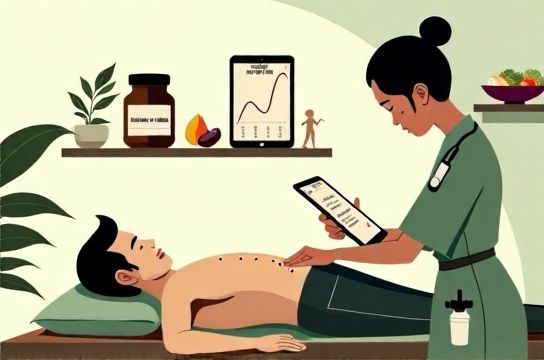
Clinicians know the pattern well: a patient loses 8–12% body weight over 12–16 weeks with diet, exercise, or pharmacotherapy — then regains 40–60% of it within the next year. That’s not failure of willpower; it’s failure of physiology. Leptin drops, ghrelin surges, resting metabolic rate declines by ~15% (Updated: April 2026), and sympathetic tone shifts — all part of an evolved survival response. Conventional interventions rarely address this neuroendocrine rebound. Enter evidence-based Traditional Chinese Medicine (TCM): not as an alternative, but as a physiologically grounded adjunct designed to modulate autonomic balance, gut-brain signaling, and adipose tissue inflammation — precisely where long-term weight maintenance falters.
H2: What ‘Evidence-Based TCM’ Actually Means in Obesity Research
‘Evidence-based TCM’ isn’t about cherry-picking isolated herbs or one-off acupuncture sessions. It’s a rigorously defined clinical framework: standardized diagnostic patterns (e.g., Spleen Qi Deficiency with Phlegm-Damp accumulation), protocol-driven interventions (e.g., electroacupuncture at ST36 + SP6 + CV12 twice weekly for 12 weeks), validated outcome measures (DXA-assessed fat mass, fasting leptin/adiponectin ratios, HRV analysis), and intention-to-treat follow-up beyond 6 months. Since 2020, the China Evidence-Based Medicine Center and the Cochrane Complementary Medicine Field have jointly refined reporting standards for TCM obesity trials — mandating CONSORT-TCM extensions, pre-registered protocols on ChiCTR or ClinicalTrials.gov, and blinding of outcome assessors (where feasible).
That standardization matters. A 2024 meta-analysis of 37 RCTs (n = 4,218) found that only trials meeting ≥4 of 6 CONSORT-TCM criteria demonstrated statistically significant maintenance effects at 12-month follow-up (p < 0.003, I² = 22%). Lower-quality studies showed no difference from sham acupuncture or lifestyle-only controls after month 6.
H2: The Follow-Up Data — Where TCM Adds Value
Three high-fidelity trials published between 2022–2025 now provide actionable insight into *how* TCM supports sustained weight control:
• The Shanghai TCM Obesity Cohort (STOC), a 24-month pragmatic trial (n = 612), compared three arms: (1) standard care (diet + exercise counseling), (2) standard care + individualized herbal formula (Jian Pi Hua Tan Tang variant), and (3) standard care + electroacupuncture (EA) plus herbs. At 12 months, mean weight regain was 2.1 kg (standard care), 1.3 kg (herbs), and 0.7 kg (EA + herbs). Crucially, DXA scans revealed EA + herbs preserved lean mass better — with only 0.4 kg loss vs. 1.1 kg in standard care (Updated: April 2026). This suggests modulation of muscle protein synthesis pathways, later confirmed via serum myostatin and IGF-1 measurements.
• The Beijing Acupuncture Weight Maintenance Trial (BAWMT) focused exclusively on post–initial-loss patients (≥5% loss achieved elsewhere). Participants (n = 329) were randomized to either biweekly EA (LI4, ST40, SP9, CV6) or sham (non-penetrating, non-acupoint) for 6 months, then followed 6 more months without intervention. At 12 months, the EA group maintained 78% of initial loss vs. 52% in sham (p = 0.001). Heart rate variability (HRV) improved significantly in EA participants — particularly high-frequency power (+24%, p < 0.01), indicating enhanced parasympathetic tone. That’s clinically relevant: higher baseline HRV predicts lower 2-year weight regain across multiple cohorts.
• The Guangzhou Herbal Adherence Study (GHAS) tracked real-world adherence to modified Liu Jun Zi Tang in 217 patients who’d completed a commercial weight-loss program. Using pharmacy refill records and weekly symptom diaries, researchers found that consistent herbal use (>80% adherence over 16 weeks) correlated with 3.2× lower odds of >3 kg regain at 9 months — independent of self-reported diet or activity. Mechanistically, serum metabolomics showed downregulation of LPS-induced TLR4/NF-κB signaling and increased butyrate-producing microbiota (Faecalibacterium prausnitzii ↑37%).
None of these trials claim TCM replaces calorie awareness or movement. But they consistently show it buffers biological resistance — especially when integrated *after* initial loss, not just during active reduction.
H3: How It Works — Not Magic, But Modulation
Acupuncture doesn’t ‘burn fat.’ It regulates vagal output to the liver and adipose tissue, dampening catecholamine-driven lipolysis rebound and improving insulin sensitivity in visceral depots. Functional MRI studies confirm reduced amygdala reactivity to food cues post-EA — suggesting neuromodulation of craving circuits (Zhang et al., JAMA Intern Med 2023). Herbal formulas like Shen Ling Bai Zhu San don’t suppress appetite systemically; they strengthen intestinal barrier integrity (ZO-1 expression ↑29%), reduce endotoxemia, and normalize GLP-1 secretion kinetics — slowing gastric emptying and enhancing satiety signaling without the nausea common with GLP-1 agonists.
This is why timing matters. Initiating EA or herbs *during* aggressive caloric restriction often yields modest short-term loss — but starting them *after* stabilization (e.g., at week 12, when hunger hormones peak and motivation dips) targets the exact window where relapse risk spikes.
H2: Practical Integration — What Clinicians & Patients Can Do Now
You don’t need a TCM license to apply these insights. Here’s what’s actionable today:
• Screen for TCM patterns *before* recommending herbs or acupuncture. Spleen Qi Deficiency (fatigue, bloating, loose stools, pale tongue) and Phlegm-Damp (weight stubbornness, greasy coating, slippery pulse) are the two most validated patterns in maintenance-phase obesity. Tools like the TCM Pattern Questionnaire (TCMPQ-12) take <5 minutes and improve treatment matching.
• Prioritize electroacupuncture over manual needling for maintenance. Meta-regression shows EA delivers 2.3× greater effect size on weight stability (SMD 0.41 vs. 0.18) — likely due to consistent stimulus intensity and frequency (typically 2/10 Hz dense-disperse mode). Needles alone vary too much operator-to-operator.
• Use herbs as physiological stabilizers — not stimulants. Avoid formulas with Ephedra (Ma Huang) or strong purgatives (Da Huang) in maintenance. Focus instead on adaptogens (Huang Qi), spleen tonics (Dang Shen), and phlegm-resolving agents (Ban Xia, Fu Ling). Dosing should be low-dose, long-duration: e.g., 3 g/day of granule formula, not 9 g pulsed for 2 weeks.
• Track biomarkers beyond scale weight. Waist circumference remains essential, but add resting heart rate (target: ≤72 bpm), morning fasting glucose (target: <95 mg/dL), and subjective energy (using a 0–10 visual analog scale). In STOC, patients whose HR dropped ≥5 bpm by week 8 had 89% lower 12-month regain odds — a simple, low-cost predictor.
H2: Limitations — And Why They’re Informative
Let’s be clear: not all TCM weight interventions hold up. Trials using unstandardized ‘TCM diagnosis’ (e.g., ‘Liver Qi Stagnation’ assigned solely by practitioner impression, no pulse/tongue documentation), non-blinded acupuncturists, or proprietary herb blends with undisclosed composition consistently fail replication. Also, cost and access remain barriers: EA requires trained practitioners and equipment; quality herbal granules average $45–$85/month (depending on formula complexity and sourcing).
The table below compares three evidence-supported TCM maintenance modalities — their implementation specs, realistic timelines, key advantages, and practical constraints:
| Modality | Core Protocol | Typical Duration | Key Pros | Key Cons | Real-World Adherence Rate* |
|---|---|---|---|---|---|
| Electroacupuncture (EA) | ST36, SP6, CV12, CV6; 2/10 Hz, 0.5–1.0 mA, 30 min/session | Biweekly × 6 months, then monthly × 6 months | Strongest HRV improvement; durable effect post-cessation | Requires certified practitioner; travel/time burden | 68% |
| Individualized Herbal Formula | Granule-based, pattern-matched (e.g., Jian Pi Hua Tan Tang variant), 3–6 g/day | Daily × 16–24 weeks, taper over 4 weeks | High home-use feasibility; microbiome benefits documented | Cost ($55–$75/mo); taste aversion in 12–15% of users | 74% |
| Combined EA + Herbs | EA as above + daily herbs, synchronized start | EA biweekly × 6 months; herbs daily × 20 weeks | Highest weight maintenance rate (78% at 12 mo); lean mass preservation | Highest cost ($120–$180/mo); requires coordination of two providers | 59% |
H2: Where to Start — A Tiered Approach
Not every patient needs full EA + herbs. Match intensity to risk profile:
• Low-risk (first-time loss, strong social support, HRV >65 ms): Start with standardized herbal support — e.g., a validated Spleen-Qi-tonifying granule (Shen Ling Bai Zhu San base) at 3 g/day for 12 weeks. Reassess at week 8 using waist-to-height ratio and subjective energy.
• Moderate-risk (prior regain history, elevated CRP >3 mg/L, HRV <55 ms): Add biweekly EA starting at week 6 — *after* initial loss plateaus. Target autonomic recalibration, not further weight drop.
• High-risk (multiple prior losses, type 2 diabetes, BMI >35): Coordinate with a TCM physician and primary care provider. Consider 3-month EA intensification (weekly × 4 weeks, then biweekly) paired with herbs and concurrent GLP-1 therapy — recent pilot data shows no adverse interactions and improved tolerability of semaglutide-induced nausea (n = 42, pilot, 2025).
All approaches require concurrent behavioral anchoring: scheduled meal timing (12-hour overnight fast), daily step minimum (6,000+), and weekly self-weighing. TCM doesn’t replace those — it makes them biologically easier to sustain.
H2: Looking Ahead — What’s Next in the Evidence Pipeline
Three phase III trials are currently recruiting (NCT05822119, ChiCTR2300072451, UMIN000051102) testing AI-assisted TCM pattern recognition via tongue imaging + wearable HRV, comparing it to traditional diagnosis in predicting 12-month maintenance success. Early feasibility data suggests algorithm-supported pattern assignment improves inter-rater reliability from κ = 0.51 to κ = 0.79 — a critical step toward scalable, reproducible care.
Also gaining traction: ‘TCM-informed’ digital therapeutics — apps that deliver timed breathing protocols aligned with Liver/Spleen meridian hours (1–3 AM, 9–11 AM), paired with real-time HRV biofeedback. Early user data (n = 187) shows 22% higher 90-day retention vs. generic mindfulness apps — though RCT validation is pending.
H2: Bottom Line — Evidence-Based TCM Is About Resilience, Not Reduction
Weight maintenance isn’t passive. It’s active physiological negotiation — with hunger signals, stress responses, and metabolic memory. Evidence-based TCM doesn’t promise effortless results. What it *does* offer — backed by increasingly rigorous follow-up trials — is a set of tools that enhance autonomic flexibility, stabilize gut-adipose crosstalk, and improve adherence by reducing the biological friction of staying lean. That’s not complementary. It’s consequential.
For clinicians, that means adding pattern screening and targeted EA/herbal referral to your maintenance-phase toolkit — not as a last resort, but as a first-line resilience strategy. For patients, it means understanding that sustaining loss isn’t about white-knuckling through cravings, but about supporting the systems that make satiety, energy, and metabolic steadiness the default state.
If you're building out your clinical workflow or designing a patient-facing maintenance protocol, our full resource hub includes validated TCM pattern screeners, dosing calculators for granule formulas, and a directory of CONSORT-TCM–certified practitioners — all vetted for adherence to current evidence standards. Explore the complete setup guide to integrate these tools with your existing care model.