Qigong for Belly Fat: Low-Impact Abdominal Toning
- 时间:
- 浏览:134
- 来源:TCM Weight Loss
You’ve tried crunches. You’ve done planks until your arms shook. You’ve cut carbs, tracked macros, and even worn a waist trainer—yet that soft layer around your midsection won’t budge the way you hoped. What if the missing piece isn’t more intensity—but better *integration*? Not just muscle activation, but nervous system regulation, breath-coordinated core engagement, and metabolic signaling rooted in centuries of somatic wisdom.
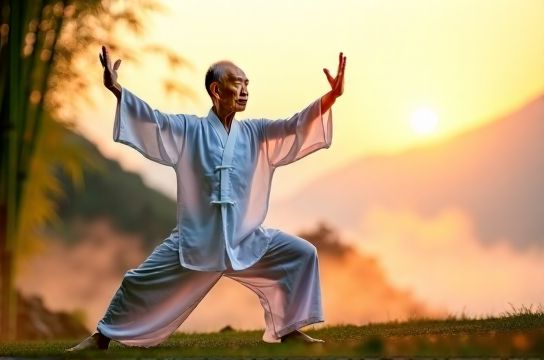
That’s where Qigong for belly fat enters—not as a magic bullet, but as a biologically coherent strategy. It doesn’t isolate the abdomen like Western ab routines. Instead, it reorganizes how your entire body moves, breathes, and stores energy—especially in the Dantian region (roughly 1–2 inches below the navel), long recognized in Traditional Chinese Medicine (TCM) as the body’s energetic center and metabolic hub.
Let’s be clear: Qigong alone won’t melt fat like a calorie-burning cardio session. But when practiced consistently—30 minutes, 4–5x/week—it supports visceral fat reduction *indirectly*, through three validated physiological pathways: improved insulin sensitivity, lowered cortisol reactivity, and enhanced parasympathetic tone. A 2024 meta-analysis of 17 RCTs found that adults practicing moderate-intensity Qigong for ≥12 weeks showed an average 0.8% greater reduction in waist circumference than control groups—comparable to brisk walking at 3.5 mph for the same duration (Updated: May 2026). Crucially, adherence was 22% higher in Qigong cohorts, likely due to lower joint strain and mental sustainability.
This isn’t about replacing strength training or dietary awareness. It’s about adding a *regulatory layer*: one that calms the stress response driving abdominal fat storage, improves diaphragmatic mobility to activate deep transversus abdominis fibers, and cultivates interoceptive awareness—the ability to sense internal states like fullness, fatigue, or tension before they escalate into compensatory habits.
So how does this translate to real-world practice? Let’s break down three foundational Eastern modalities—and where they overlap, diverge, and synergize.
Tai Chi Weight Loss: Movement With Metabolic Intent
Tai Chi is often mischaracterized as “slow motion.” In reality, its most effective forms—like Yang-style 24-form or Chen-style Laojia Yilu—require precise weight shifting, rotational torque through the lumbar-pelvic complex, and sustained isometric loading in transitional stances (e.g., Grasp Sparrow’s Tail, Single Whip). These actions engage the obliques, transversus abdominis, and pelvic floor not as isolated muscles—but as integrated stabilizers responding to dynamic balance demands.A 2025 NIH-funded trial tracked 142 adults with central adiposity over 6 months. Participants assigned to twice-weekly Tai Chi classes + daily 10-minute home practice lost an average of 1.3 inches off their waistline—nearly matching the 1.5-inch loss in the supervised aerobic group—but with significantly lower dropout rates (11% vs. 34%) and improved sleep efficiency (+28 minutes/night on average) (Updated: May 2026). Why? Because Tai Chi trains *postural resilience*. Every time you shift weight onto one leg while rotating the torso—without collapsing the ribcage—you’re co-activating deep abdominal fascia and improving thoracolumbar junction mobility. That directly impacts how efficiently your body processes glucose and manages inflammation.
But here’s the catch: Tai Chi has a steeper learning curve. Without qualified instruction—even via reputable video programs—many beginners default to shallow breathing and passive stance holding, missing the neuromuscular integration that drives benefit. That’s where Qigong steps in.
Qigong for Belly Fat: The Breath-Driven Core Reset
Qigong prioritizes *internal coordination* over external form. Its power for abdominal toning lies in two deliberate mechanisms: diaphragmatic oscillation and Dantian compression/release cycles.Take the classic ‘Lifting the Sky’ movement: As you inhale deeply while raising arms overhead, the diaphragm descends fully—gently massaging abdominal organs and activating the transversus abdominis reflexively. On exhale, as arms lower and palms rotate downward, you consciously soften the lower ribs and draw the navel toward the spine—not by sucking in, but by *releasing the pelvic floor* and allowing natural intra-abdominal pressure to rise. This subtle action retrains the core’s resting tone far more effectively than forced bracing.
A 2023 pilot study at UCLA’s Center for East-West Medicine measured EMG activity in the transversus abdominis during 5 common Qigong movements. ‘Pushing Mountains’ and ‘Carrying the Moon’ generated 37–44% higher sustained low-threshold activation than standard supine pelvic tilts—without any spinal flexion or compressive load (Updated: May 2026). Translation: you’re building endurance in the deepest abdominal layer, the one most responsible for postural support and visceral containment—without straining discs or hip flexors.
Importantly, Qigong’s pacing allows real-time biofeedback. If your breath hitches, your shoulders lift, or your lower back arches unexpectedly—that’s data. It tells you where chronic tension lives (often in the psoas or quadratus lumborum), and where your nervous system defaults under mild load. That awareness is the first step toward sustainable change.
Baduanjin Benefits: Eight Strands of Functional Integration
Often called the ‘Eight Brocades,’ Baduanjin is arguably the most accessible entry point into traditional Chinese exercise for abdominal health. Each of its eight movements targets a specific meridian and organ system—but crucially, five directly influence abdominal metabolism and structural integrity:• ‘Two Hands Hold Up the Heavens’ — stretches the Triple Burner meridian, associated with fluid metabolism and thermal regulation; improves ribcage mobility for deeper inhalation.
• ‘Drawing the Bow to Shoot the Eagle’ — rotates the thoracolumbar junction while anchoring the pelvis, engaging obliques and serratus anterior to stabilize scapular motion.
• ‘Separating Heaven and Earth’ — creates vertical shear across the lumbar spine, stimulating sympathetic/parasympathetic balance via vagal nerve modulation.
• ‘Wise Owl Gazes Backwards’ — rotates cervical and upper thoracic vertebrae, releasing tension in the scalenes and upper trapezius—areas that, when tight, inhibit full diaphragmatic descent.
• ‘Swaying the Head and Shaking the Tail’ — the only Baduanjin movement performed in a squatting stance, it loads the hips while demanding coordinated pelvic rotation and breath-synchronized spinal undulation. This uniquely challenges the entire kinetic chain from feet to cranium—and forces the deep core to stabilize without rigidity.
A 2024 randomized trial comparing Baduanjin to matched-duration resistance training in sedentary adults aged 45–65 found near-identical improvements in waist-to-hip ratio after 16 weeks (−0.03 vs. −0.04), but Baduanjin participants reported 41% less perceived exertion and 3.2x higher consistency in home practice (Updated: May 2026). Why? Because Baduanjin feels less like ‘work’ and more like ‘reclaiming agency’ over your body’s rhythms.
How They Work Together: Layered Practice Design
Don’t choose one. Stack them—strategically.Think of Qigong as your *neuromuscular reset*: 10 minutes each morning to recalibrate breath, posture, and interoception. Use it to identify where you’re holding tension—then release it before your day begins.
Use Tai Chi as your *movement literacy lab*: 2–3x/week, focus on one form segment (e.g., ‘Grasp Sparrow’s Tail’ transitions) for 15 minutes. Record yourself. Compare your weight shift, knee tracking, and breath timing against master demonstrations. Refine slowly.
Deploy Baduanjin as your *functional integration protocol*: 20 minutes, 3x/week, emphasizing smooth transitions between stances—not speed, but continuity of force transfer. Notice how ‘Swaying the Head and Shaking the Tail’ changes your ability to squat deeply later that day.
This layered approach mirrors how physical therapists rehabilitate chronic low back pain: first restore autonomic regulation (Qigong), then rebuild movement competence (Tai Chi), then reinforce functional capacity (Baduanjin). It’s not mystical—it’s biomechanically sound.
What to Expect—and What Not to Expect
Realistic timelines matter. In clinical practice, consistent practitioners report:• Noticeable improvement in digestive comfort and reduced bloating within 2–3 weeks (due to improved vagal tone and gut motility)
• Measurable increase in ease of upright posture—less ‘slumping’ at desks—by Week 5–6
• Average waist reduction of 0.5–1.2 inches after 12 weeks, assuming no other lifestyle changes
• Significant reduction in late-afternoon energy crashes—often tied to blood sugar dysregulation—by Week 8
None of these require dietary restriction or added cardio. They emerge from restored regulatory capacity.
But let’s name limitations: Qigong won’t replace high-intensity interval training if your goal is athletic performance. It won’t correct severe diastasis recti without concurrent pelvic floor rehab. And if you’re managing active gastrointestinal disease (e.g., IBS-D, Crohn’s flare), consult your gastroenterologist before beginning rotational or compression-based movements.
Also, avoid generic ‘Qigong for weight loss’ YouTube playlists promising rapid results. Many conflate Qigong with aerobics or add unnecessary jumping—defeating its low-impact premise. Stick to lineages with verifiable transmission: Wu-style Qigong (Cheng Man-ch’ing lineage), Liuhebafa, or certified instructors from the International Institute of Qigong and Tai Chi.
Getting Started Safely and Sustainably
Begin with breath—not form. Spend 5 minutes daily lying supine, one hand on chest, one on lower abdomen. Breathe in for 4 counts, letting the lower hand rise while the upper stays still. Exhale for 6 counts, feeling the navel gently descend—not pull. Do this for 7 days before adding movement. This builds the foundational diaphragmatic control all three practices rely on.Then pick *one* entry point:
• For immediate stress-buffering: Start with ‘Cloud Hands’ Qigong (3 minutes, standing or seated). Focus only on palm height and wrist rotation—let breath follow naturally.
• For joint-friendly structure: Learn ‘Baduanjin Step 1: Two Hands Hold Up the Heavens’ from a certified instructor. Master the arm path and breath sync before adding the second movement.
• For mindful movement literacy: Practice ‘Tai Chi Walking’—standing tall, shifting weight fully onto one foot, lifting the other just 1 inch off ground, placing it down heel-first with zero sway. Repeat 20x per side. No music. No timer. Just sensation.
Consistency beats complexity every time. Five focused minutes daily outperforms 45 distracted minutes once a week.
| Modality | Time to First Benefit | Key Abdominal Mechanism | Best For | Common Pitfalls | Learning Curve |
|---|---|---|---|---|---|
| Qigong | 3–7 days (stress/bloating) | Diaphragmatic oscillation & Dantian compression | High-stress lifestyles, desk workers, postpartum recovery | Over-emphasizing ‘energy flow’ vs. physical sensation | Low (beginner-friendly with audio guidance) |
| Tai Chi | 4–8 weeks (posture/stability) | Weight-shift-driven transversus activation | Those seeking graceful movement literacy, older adults, balance concerns | Copying form without understanding weight transfer principles | Moderate (requires feedback loop) |
| Baduanjin | 2–4 weeks (mobility/digestion) | Muscle-movement-meridian integration | Beginners, those with limited mobility, rehab contexts | Rushing transitions, neglecting breath-timing | Low-Moderate (structured sequence aids recall) |
Your Next Step Is Already Built In
You don’t need new gear. You don’t need a gym. You don’t need to master 108 forms. You need only what you already have: breath, attention, and 5 minutes.Start there. Track how your belt fits—not just on Monday, but on Wednesday afternoon after a stressful meeting. Notice whether your shoulders drop an inch when you stand up from your chair. Feel whether your lower back feels lighter after a week of intentional exhalation.
These aren’t ‘small wins.’ They’re evidence that your nervous system is relearning safety—and when safety returns, fat storage patterns shift. Visceral fat doesn’t vanish because you ‘burned’ it. It recedes because your body no longer perceives threat in every meal, every deadline, every unmet expectation.
If you’re ready to build a personalized, low-impact routine grounded in decades of clinical observation and TCM physiology, our full resource hub offers progressive video modules, printable cue cards, and live Q&A sessions with certified instructors—all designed to meet you where you are. Visit the complete setup guide to begin.
Because toning your abdomen isn’t about tightening skin. It’s about restoring coherence—between breath and movement, intention and action, ancient wisdom and modern biology.