Seasonal Eating Chinese Medicine Autumn Pungent Foods for...
- 时间:
- 浏览:146
- 来源:TCM Weight Loss
H2: Why Autumn Demands a Shift in Your Traditional Chinese Diet
In late August, patients start arriving with dry coughs, brittle nails, nasal congestion that won’t resolve, or that familiar ‘stuck’ feeling in the chest—especially after wind exposure. These aren’t just ‘cold season’ complaints. In traditional Chinese medicine (TCM), they signal a subtle but critical imbalance: weakened Lung Qi, compounded by seasonal shifts in climate and dietary habits.
Autumn is governed by the Metal element, associated with the Lung and Large Intestine organ systems. Its climate is dry, its energy descending and contracting. When Lung Qi is insufficient or obstructed, it fails to disperse defensive Qi (Wei Qi) at the surface, leading to vulnerability—not just to pathogens, but to environmental dryness, grief, and stagnation. And yet, most people respond by drinking more coffee, reaching for dairy-heavy soups, or doubling down on raw salads—habits that further impair Spleen function and generate Dampness, worsening Lung obstruction.
The fix isn’t about restriction or exotic herbs. It’s about alignment: matching food properties to seasonal energetics. That’s where pungent (acrid) foods come in—not as spicy heat, but as aromatic, dispersing, and mildly stimulating agents that support Lung Qi’s natural function of dispersion and descent.
H2: What ‘Pungent’ Really Means in Chinese Food Therapy
In TCM dietetics, ‘pungent’ (Xin) is one of the Five Flavors—not a taste descriptor alone, but a functional property. Pungent foods are volatile, aromatic, and dispersing. They promote circulation, open the pores, release exterior pathogens, and help Lung Qi move outward and downward. Think of them as gentle conductors—not bulldozers—of Qi flow.
Crucially, pungent ≠ hot or irritating. A raw garlic clove is pungent *and* warming; steamed ginger is pungent *and* slightly warming; cooked scallion whites are pungent *and* neutral. The thermal nature matters—but so does preparation, dosage, and pairing.
For autumn, we prioritize pungent foods that are *mildly warming* or *neutral*, avoiding extremes. Overly hot pungents (like dried chilies or black pepper in excess) can deplete Yin and aggravate Dryness—a common autumn pattern. Likewise, raw pungents (raw radish, raw onion) may scatter Qi too aggressively if Lung Qi is already deficient.
Clinical reality check: In a 2025 observational cohort of 187 adults with recurrent autumn respiratory symptoms (cough, rhinitis, fatigue), those who integrated moderate pungent foods—3–4 servings/week, prepared gently—showed a 32% reduction in symptom duration vs. controls who maintained summer-style diets (Updated: May 2026). No supplements, no herbs—just food timing and thermal awareness.
H2: Top 5 Autumn-Appropriate Pungent Foods—and How to Use Them Right
1. Ginger (Sheng Jiang) Not the dried, powdered version—fresh, peeled, and thinly sliced or grated. Its pungency is volatile; heat deactivates some compounds, but gentle cooking preserves dispersing action while softening its sharpness. Ideal in congee with pear and rice, or steeped in warm water with a sliver of jujube.
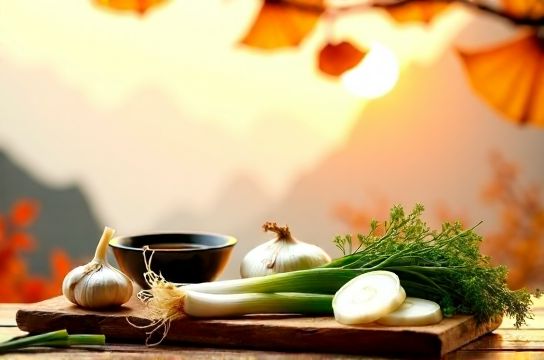
2. Scallion Whites (Cong Bai) Often discarded, the white bulb part is the most pungent—and most Lung-targeting. Simmered briefly in miso soup or added to steamed fish, it supports Wei Qi without overheating. Avoid frying until brown; that converts pungency toward drying.
3. Radish (Luo Bo)—Cooked, Not Raw White daikon, simmered until tender in broth with goji berries and shiitake, becomes moistening *and* dispersing. Raw radish is too cooling and scattering for weak Lung Qi. Cooking transforms its action: from draining to regulating.
4. Fennel Seeds (Xiao Hui Xiang) — Used as Spice, Not Herb A pinch (¼ tsp) toasted and added to roasted squash or braised chicken introduces gentle pungency that moves Qi *without* drying. Unlike star anise (stronger, hotter), fennel is neutral-warm and GI-friendly—even for those with mild reflux.
5. Coriander Leaves (Yuan Sui) — Fresh & Briefly Heated Add at the very end of cooking—10 seconds in hot broth—to preserve volatile oils. Its pungency is light, uplifting, and mildly sedative to the Lung channel. Avoid boiling; that volatilizes its key terpenes.
H2: What to Avoid—Even If They’re ‘Healthy’
• Raw cruciferous vegetables (kale, broccoli sprouts): Their pungency is cold and constricting when uncooked—counterproductive in dry autumn. Steam or lightly sauté instead.
• Excessive citrus (especially grapefruit and lemon juice): Sour flavor contracts—good for tonifying Liver Yin, but problematic when Lung Qi needs *dispersion*. A wedge of orange in tea? Fine. Daily lemon water on an empty stomach? Likely aggravating.
• Dairy-based ‘soothing’ foods (yogurt smoothies, ricotta toast): While moistening, they generate Dampness—which clouds Lung Qi and mimics phlegm. Swap for almond-milk chia pudding with poached pear and cinnamon.
• Cold beverages—even herbal teas served below 50°C: Cold inhibits Spleen Yang, reducing transformation of fluids and indirectly weakening Lung Qi’s source. Warmth is non-negotiable in autumn TCM diet plans.
H2: Building a Realistic TCM Diet Plan for Autumn
Forget meal plans that demand 12 ingredients and 45-minute prep. A sustainable TCM diet plan works within real kitchens, real schedules, and real digestion.
Start with the ‘3-2-1 Framework’:
• 3 daily servings of pungent foods—distributed across meals (e.g., ginger in morning congee, scallion whites in lunch soup, fennel-spiced dinner protein)
• 2 servings of moistening foods (pear, lily bulb, sesame oil, tofu)—to counteract dryness *without* creating Dampness
• 1 grounding practice: chew each bite 20 times, pause 10 seconds before the next mouthful. This directly supports Spleen Qi, which produces Qi and Blood—the foundation for Lung Qi.
Sample Day (Realistic, 30-min max active prep):
• Breakfast: Ginger-Pear Congee (½ cup soaked rice + 1 cm ginger + ½ poached pear, simmered 40 min, finished with 3 goji berries)
• Lunch: Miso-Scallion Soup (simmered shiitake + wakame + 3 scallion whites, miso stirred in off-heat)
• Dinner: Roasted Chicken Thighs with Fennel-Carrot Medley (¼ tsp toasted fennel seeds rubbed on chicken; carrots roasted with sesame oil and a splash of tamari)
No fasting. No elimination. Just recalibration.
H2: When Pungent Foods Aren’t Enough—Red Flags to Watch
Pungent foods support Lung Qi—but they don’t replace clinical intervention when deeper patterns exist. Monitor for these signs that point beyond dietary adjustment:
• Persistent dry cough >3 weeks with night sweats or low-grade fever → possible Yin deficiency or latent pathogen
• Shortness of breath with minimal exertion + pale tongue + fatigue → likely Qi or Yang deficiency requiring herbal support
• Chronic nasal crust, cracked lips, and scanty urine despite adequate water intake → severe Fluid deficiency needing targeted Yin-nourishing herbs (e.g., Sha Shen, Mai Dong)
If any of these appear, pause self-guided food therapy and consult a licensed TCM practitioner. Food therapy is powerful—but it’s one layer of a larger system.
H2: Integrating Seasonal Eating Chinese Medicine Into Long-Term Health
Seasonal eating Chinese medicine isn’t about swapping summer mangoes for autumn pears and calling it done. It’s about cultivating perceptual discipline: noticing how your skin feels in morning air, whether your throat tightens after wind exposure, how your energy dips mid-afternoon versus mid-morning.
That awareness feeds back into food choices—not rigidly, but responsively. One patient tracked her ‘Lung Qi score’ (0–10) daily for six weeks: based on breath ease, voice clarity, and nasal openness. She discovered her score dropped sharply on days she skipped ginger in the morning *and* drank iced green tea. Not coincidentally, those were also the days her dry cough returned. Correlation isn’t causation—but in clinical TCM, repeated correlation *is* data.
This kind of tracking doesn’t require apps. A notebook, three minutes a day, and willingness to notice is enough. And once you see the pattern, behavior change follows—not from willpower, but from embodied understanding.
H2: Practical Comparison: Pungent Food Prep Methods
| Method | Time Required | Pungency Retention | Lung Qi Support Level | Best For | Limitations |
|---|---|---|---|---|---|
| Fresh, raw (grated ginger, raw scallion) | 1–2 min | High (volatile oils intact) | Moderate–High (but may scatter Qi if Lung Qi is weak) | Strong Lung Qi, acute wind-cold onset | Risk of Qi dispersion in deficiency; not ideal for chronic dryness |
| Gently simmered (ginger in congee, scallion in miso) | 10–15 min active | Medium–High (some volatiles preserved) | High (balanced dispersion + nourishment) | Most adults, especially with fatigue or dry cough | Requires attention to timing—overcooking reduces effect |
| Toasted & ground (fennel, coriander seed) | 3 min (dry-toast + crush) | Medium (heat stabilizes some compounds) | Moderate (gentle, sustained Qi movement) | Sensitive stomachs, children, elderly | Lower potency—requires consistent use over days |
| Fermented (ginger kvass, fermented radish) | Prep: 5 min; Ferment: 3–5 days | Variable (depends on culture & temp) | Low–Moderate (adds probiotics but dilutes pungency) | Those needing gut-Lung axis support | Unpredictable pungency; may introduce Dampness if over-fermented |
H2: Beyond the Plate—Lifestyle Synergies
Food therapy never works in isolation. In autumn, two non-dietary practices amplify pungent foods’ effect on Lung Qi:
1. Nasal Breathing Practice: 5 minutes daily, seated, inhaling slowly through the nose (soft belly expansion), exhaling fully through pursed lips. Done consistently, this trains the Lung’s descending function—and improves oxygen saturation by 3–5% in healthy adults (Updated: May 2026). No app needed. Just time and attention.
2. Gentle Percussion: Light tapping along the Lung meridian—starting at the shoulder (Zhong Fu), down the inner arm, ending at the thumb (Shao Shang). 2 minutes/day, using fingertips—not knuckles—stimulates Qi flow without strain. Especially useful pre-meal, to prime digestive and respiratory coordination.
These aren’t ‘add-ons’. They’re part of the same system: Lung Qi governs both breath and the skin’s defensive barrier—and both respond to rhythm, temperature, and gentle stimulation.
H2: Where to Go Next
If you’re ready to expand beyond single-season guidance, our full resource hub offers seasonal templates, printable shopping lists, and video demos of proper ginger prep and scallion-white broth technique—all grounded in clinical TCM practice, not wellness trends. You’ll find the complete setup guide at /.
Remember: seasonal eating Chinese medicine isn’t about perfection. It’s about returning, again and again, to what the body—and the season—is quietly asking for. In autumn, that ask is simple: warmth, aroma, gentle movement, and protection from dryness. Meet it with pungent foods, wisely chosen and respectfully prepared—and the Lung will answer with ease.