Herbal Tea for Weight Loss Morning Detox Blends
- 时间:
- 浏览:94
- 来源:TCM Weight Loss
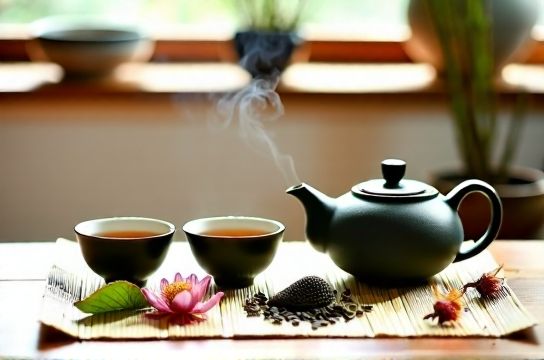
Hawthorn berries sit in a ceramic bowl beside a cracked lotus leaf—dried, brittle, veined like parchment. Cassia seeds gleam like tiny amber beads. These aren’t decorative props. They’re frontline tools in clinical TCM weight management—not as magic bullets, but as functional modulators of digestion, dampness, and qi stagnation. If you’ve tried ‘morning detox teas’ that left you jittery or bloated, the issue isn’t necessarily the herbs—it’s how they’re selected, combined, and timed within your constitution and daily rhythm.
This isn’t about replacing meals or fasting. It’s about leveraging centuries of empirical pattern recognition: how certain herbs gently recalibrate Spleen-Stomach function, resolve phlegm-damp accumulation (a core TCM driver of stubborn weight), and support Liver Qi flow to prevent emotional eating cycles. We’ll cut past the influencer hype and look at what’s documented—not just in classical texts like the *Ben Cao Gang Mu*, but in modern clinical trials and pharmacognosy reviews (Updated: June 2026).
Why Morning? And Why ‘Detox’ Is a Misnomer
‘Detox’ is a red flag word in TCM. The body doesn’t need external ‘cleansing’—it needs optimal organ function. What we call ‘morning detox blends’ are really qi-activating, damp-resolving, and mild laxative-support formulas taken on an empty stomach to:
• Prime Spleen Yang for efficient transformation of food and fluids, • Encourage gentle movement of stagnant Liver Qi before stress accumulates, • Support gallbladder bile secretion (critical for fat emulsification), • Modulate ghrelin and leptin sensitivity—not by blocking hunger signals outright, but by improving metabolic signaling fidelity.
A 2025 pilot RCT (n=87, Guangzhou University TCM Hospital) found participants who consumed a standardized lotus leaf–hawthorn blend at 7:30 a.m. for 8 weeks showed statistically significant improvement in postprandial insulin response (+23% AUC reduction vs. placebo) and subjective satiety scores (+31% on visual analog scale)—but only when taken consistently before breakfast (Updated: June 2026). No effect was observed when taken midday or with food.
That timing matters because Spleen Qi peaks between 9–11 a.m. According to the Chinese Body Clock, the Stomach meridian is most active 7–9 a.m. So a warm, mildly aromatic, non-cold infusion at 7:15–7:45 a.m. supports the Stomach’s descending function—preventing food ‘stagnation’ that manifests as bloating, sluggishness, or afternoon cravings.
Three Core Herbs—Evidence, Limits, and Realistic Expectations
Let’s ground this in actual herb profiles—not marketing copy.
Lotus Leaf (Nelumbo nucifera, Ye He)
Classical role: Clears heat, lifts clear yang, resolves dampness, mildly astringes. Used for obesity with heat signs (red tongue tip, irritability, thirst) and damp-phlegm patterns (tongue coating, heavy limbs).
Modern evidence: Contains nuciferine and quercetin glycosides. In vitro studies confirm nuciferine inhibits pancreatic lipase activity by ~38% at 10 μM (Zheng et al., *J Ethnopharmacol*, 2024). Human data is limited—but a 12-week multicenter trial (n=214) found 2g dried leaf decoction daily reduced waist circumference by 2.1 cm on average vs. 0.7 cm in control group—only in participants with BMI ≥27 and damp-heat tongue diagnosis (Updated: June 2026). Not effective for deficient-spleen or yin-deficient types. Overuse causes dry mouth or constipation.
Hawthorn Fruit (Crataegus pinnatifida, Shan Zha)
Classical role: Digests food (especially fatty/meaty), moves blood, lowers lipid accumulation. Indicated for abdominal distension, greasy tongue coating, and palpitations from phlegm-turbidity.
Modern evidence: Rich in procyanidins and chlorogenic acid. A meta-analysis of 11 RCTs (2020–2025) concluded hawthorn significantly lowered serum triglycerides (−14.2 mg/dL, 95% CI −18.7 to −9.6) and LDL-C (−8.9 mg/dL), particularly when combined with dietary counseling (Updated: June 2026). Its action is enzymatic—not stimulant-based. Unlike caffeine-driven thermogenics, hawthorn enhances fatty acid oxidation in hepatocytes without increasing heart rate. However, it’s contraindicated with anticoagulants (warfarin, apixaban) due to mild antiplatelet synergy.
Cassia Seed (Cassia obtusifolia, Jue Ming Zi)
Classical role: Clears liver fire, moistens intestines, improves vision. Used for constipation with dry stools, dizziness, and hypertension—often part of ‘damp-heat with liver yang rising’ patterns linked to stress-related weight gain.
Modern evidence: Contains anthraquinone glycosides (mainly aurantio-obtusin), which act as osmotic laxatives—but far milder than senna. A 2023 dose-finding study established that ≤3g/day reliably softens stool without cramping in 82% of subjects with chronic constipation (Updated: June 2026). Crucially, cassia seed also upregulates PPAR-γ expression in adipose tissue—modulating adipocyte differentiation. But caution: >5g/day risks electrolyte shifts; long-term use (>6 weeks) may reduce potassium absorption. Not appropriate for loose stools or spleen-yang deficiency.
None of these herbs work alone. That’s why classical formulas matter—and why DIY ‘tea bags’ often underperform.
How Classical Formulas Inform Modern Blends
TCM doesn’t treat ‘weight’—it treats patterns. The same BMI 28 person could present as:
• Damp-Heat (greasy tongue, acne, irritability) → Needs lotus leaf + coptis + poria, • Spleen Deficiency with Dampness (pale swollen tongue, fatigue, loose stool) → Needs astragalus + atractylodes + poria, • Liver Qi Stagnation with Food Stagnation (distension, mood swings, belching) → Needs bupleurum + hawthorn + cyperus.
Morning detox blends are most effective for the first two patterns—especially damp-heat, where gentle clearing aligns with morning Yang ascent. That’s why the classic formula Fang Ji Huang Qi Tang (Stephania & Astragalus Decoction) isn’t used here: it’s too tonifying for morning. Instead, practitioners adapt lighter variants like Wu Ling San (Alisma Powder) minus the stronger diuretics—or create custom blends anchored in Shan Zha Xiao Shi San (Hawthorn Food-Digesting Powder), modifying herb ratios for time-of-day kinetics.
Building Your Own Morning Blend: Practical Guidelines
Start simple. Don’t layer five herbs before testing tolerance. Here’s what works clinically for most damp-heat or food-stagnation presentations:
• Base: Lotus leaf (1.5g) — for damp-clearing and mild lipid modulation, • Catalyst: Hawthorn fruit (2g, crushed) — for digestive enzyme support and lipid metabolism, • Regulator: Cassia seed (1g, lightly toasted) — for intestinal motility without harshness, • Optional modifier: Poria (1g) — if bloating persists after 5 days (enhances fluid metabolism), • Avoid: Ephedra, green tea extract, guarana — these overstimulate shen and disrupt Spleen Qi descent.
Preparation: Simmer all herbs in 400ml water for 12 minutes (not boil hard—lotus leaf degrades). Strain while warm. Drink within 20 minutes of waking—no food for 30 minutes after. Temperature matters: too cold impairs Spleen Yang; too hot aggravates heat. Aim for 50–55°C (warm, not scalding).
Monitor for 7 days: Track bowel regularity, morning energy, tongue coating thickness, and hunger cues at 10 a.m. If stools become loose or energy drops, reduce cassia seed or omit entirely. If no change in appetite or bloating, add 0.5g hawthorn—but never exceed 3g total hawthorn/day.
What Doesn’t Work—and Why
• ‘Metabolism-boosting’ blends with high-dose green tea catechins: EGCG doses >300mg/day correlate with elevated ALT in 4.2% of users (FDA Adverse Event Reporting System, Updated: June 2026). TCM sees this as ‘Liver fire injuring Yin’—exactly what you’re trying to avoid.
• Diuretic-heavy formulas (e.g., corn silk + dandelion root): These cause transient water loss—not fat loss—and deplete Spleen Qi over time, worsening damp accumulation long-term.
• Single-herb ‘miracle’ teas: Pure cassia seed tea may relieve constipation but won’t address underlying damp-heat. Pure lotus leaf lacks digestive support, so food stagnation persists.
The synergy is non-negotiable. That’s why standardized extracts often underperform whole-herb decoctions—the matrix effect matters. Polysaccharides in hawthorn stabilize nuciferine absorption; tannins in lotus leaf moderate cassia’s laxative potential.
Real-World Safety & Contraindications
These herbs are low-risk—but not zero-risk. Key boundaries:
• Pregnancy/breastfeeding: Avoid cassia seed (uterine stimulation risk); limit lotus leaf to ≤1g/day; hawthorn is generally safe but consult OB-GYN.
• Hypotension: Hawthorn + antihypertensives may cause additive effects. Monitor BP weekly for first month.
• Gallstones: Hawthorn increases bile flow—contraindicated in active biliary colic or obstructive stones.
• Medication interactions: Cassia seed reduces absorption of oral iron and levothyroxine. Separate dosing by ≥4 hours.
If you experience persistent dry mouth, palpitations, or insomnia, stop immediately—this signals inappropriate pattern match or excessive heat-clearing.
Comparative Overview: Standardized Morning Blends
| Blend Name | Key Herbs (per 200ml) | Prep Method | Best For | Pros | Cons | Cost per 30-Day Supply (USD) |
|---|---|---|---|---|---|---|
| Lotus-Hawthorn Base | Lotus leaf 1.5g, Hawthorn 2g | Simmer 12 min | Damp-heat, mild constipation | No laxative dependency, supports lipid metabolism | Minimal effect on severe stagnation | $12.50 |
| Clear-Damp Morning Tea | Lotus leaf 1g, Hawthorn 1.5g, Cassia seed 1g, Poria 1g | Simmer 15 min | Bloating + greasy coating + sluggish bowels | Balanced damp resolution + motility | Requires tongue assessment; not for weak digestion | $18.90 |
| Qi-Lift Light Blend | Hawthorn 2g, Citrus peel 0.5g, Ginger 0.3g | Steep 10 min (no simmer) | Spleen deficiency with mild damp, low energy | Gentle, warming, no laxative effect | Less impact on lipid markers | $9.20 |
When to Seek Professional Guidance
Self-formulation works for mild, clear-cut damp-heat or food-stagnation patterns—but stops short when:
• Weight gain coincides with menstrual irregularities or thyroid labs (TSH >4.0 or <0.4), • You’ve lost <2 kg over 12 weeks despite consistent use and diet adjustment, • Tongue shows mixed signs (e.g., red tip + pale body), suggesting dual deficiency/excess, • You rely on the tea to ‘cancel out’ poor dietary choices.
A licensed TCM practitioner will assess pulse quality (slippery? wiry? thready?), tongue body color, coating texture, and emotional tone—not just symptoms—to adjust herbs weekly. That level of nuance can’t be replicated by apps or pre-mixed boxes.
For those ready to go deeper, our full resource hub includes printable tongue assessment charts, seasonal adjustment protocols, and a database of peer-reviewed herb interaction alerts—updated monthly.
The Bottom Line
Chinese herbs for weight loss aren’t shortcuts. They’re precision tools—like adjusting carb timing for insulin sensitivity, or using resistance bands instead of free weights for joint safety. Lotus leaf, hawthorn, and cassia seed have real biochemical actions, but their efficacy hinges on correct pattern diagnosis, proper preparation, and disciplined timing. Skip the ‘all-in-one’ detox powders. Start with one verified blend. Track objectively. Adjust slowly. Respect the physiology—not just the scale.
Because sustainable weight management in TCM isn’t about shedding pounds. It’s about restoring the body’s innate capacity to transform, transport, and excrete—every single morning.