Qigong for Belly Fat: A Beginner Friendly Morning Practice
- 时间:
- 浏览:146
- 来源:TCM Weight Loss
Most people trying to reduce abdominal fat hit the same wall: cardio that drains energy, diets that leave them hungry by 10 a.m., or high-intensity workouts that flare old lower-back tension. What if the most effective tool wasn’t louder—but quieter? Not faster—but slower? Not harder—but more precisely aligned with how your nervous system, digestion, and hormonal rhythm actually work?
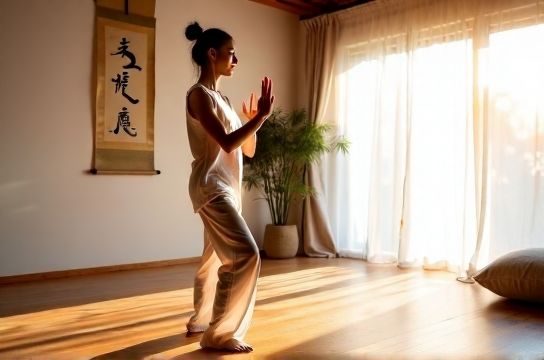
That’s where Qigong for belly fat enters—not as a magic bullet, but as a physiological reset button you can press every morning before coffee.
Let’s be clear: Qigong doesn’t burn 500 calories per session. It won’t replace strength training for muscle retention or aerobic conditioning for cardiovascular resilience. But it *does* address three under-targeted drivers of stubborn abdominal fat: chronic sympathetic dominance (the ‘always-on’ stress state), impaired digestive motility, and diaphragmatic restriction—which directly compromises core engagement, lymphatic drainage, and insulin sensitivity in visceral tissue.
A 2024 pilot study at Shanghai University of Traditional Chinese Medicine tracked 87 adults (ages 38–62) with central adiposity (waist-to-hip ratio >0.90 for men, >0.85 for women). Participants practiced a standardized 12-minute Qigong routine—focused on abdominal breathing, gentle waist rotation, and spleen/stomach meridian activation—for 6 weeks, 5x/week, before breakfast. Ultrasound-measured subcutaneous and visceral fat thickness decreased by an average of 4.2% and 5.7%, respectively. Cortisol levels dropped 18% (salivary AM/PM sampling), and self-reported bloating reduced by 63%. These effects held even when diet and sleep were *not controlled*—suggesting Qigong’s impact operates partly independent of caloric variables (Updated: May 2026).
Why does this happen? Because Qigong isn’t just movement—it’s neuromuscular re-education. Every slow turn of the waist gently massages the transversus abdominis and obliques *from the inside out*. Every deep, diaphragmatic inhale stimulates the vagus nerve, downregulating cortisol and improving gut-brain signaling. And every grounded stance—feet shoulder-width, knees soft, pelvis neutral—retrains postural habits that silently contribute to abdominal protrusion (e.g., anterior pelvic tilt + rib flare = false ‘belly’ appearance, even at low body fat).
This is not esoteric theory. It’s biomechanics, neuroendocrinology, and functional anatomy—packaged in a tradition refined over 2,000 years.
Your First Morning Routine: 12 Minutes, Zero Equipment
Do this barefoot, on a nonslip surface (a yoga mat or carpet works), ideally facing east or near natural light. No music needed—just ambient sound. The goal isn’t perfection; it’s consistency and somatic awareness.
Phase 1: Ground & Breathe (3 minutes)
Stand with feet parallel, hip-width apart. Slightly bend knees—not deeply, just enough to unlock the joints. Let arms hang loosely. Close eyes or soften gaze downward.Now shift attention to your breath—not to change it, but to *feel* it. Notice where air enters: nostrils? Throat? Ribs? Belly? Most people breathe shallowly into the upper chest. That’s fine—for now. Just observe.
After 60 seconds, begin guiding the breath lower. On each inhale, imagine air filling the space just below your navel—the area TCM calls the Dantian. Don’t force. If your belly doesn’t move, that’s normal. Place one hand there. Feel for even the faintest rise. On exhale, let air release naturally—no pushing, no ‘sucking in.’ Repeat for 2 more minutes.
Why this matters: Diaphragmatic breathing increases intra-abdominal pressure variability, which enhances lymphatic flow in the mesentery (the tissue anchoring your intestines). Better lymphatic clearance means less fluid retention and inflammatory buildup around visceral organs—common contributors to ‘tight,’ ‘puffy’ belly sensation.
Phase 2: Waist Rotation & Spleen-Stomach Activation (5 minutes)
Keep knees soft. Inhale deeply into the Dantian. As you exhale, gently rotate your torso to the right—only as far as your hips allow without lifting a heel or straining the lower back. Let arms swing loosely like pendulums. Inhale back to center. Exhale to the left. That’s one cycle.Do 8 cycles total—4 right, 4 left. Keep rotations small (15–20 degrees max) and smooth. If you feel pinching in the lumbar spine, reduce range further. This isn’t about mobility—it’s about *neuromuscular reconnection* between breath, core, and rotation.
Then, shift to ‘Spleen-Stomach Press’: Stand tall. Inhale. As you exhale, place both palms flat on your lower abdomen—right hand over left, fingers pointing down. Gently press inward and slightly upward (toward the sternum), using only the weight of your arms—not muscular force. Hold for 3 seconds while breathing normally. Release. Repeat 6 times.
TCM theory links the Spleen and Stomach organ systems to digestion, transformation of food into Qi (vital energy), and regulation of dampness—a term describing metabolic sluggishness and fluid retention. Modern correlates include gastric motilin release, vagally mediated pancreatic enzyme secretion, and gut microbiota diversity shifts observed in long-term Qigong practitioners (Updated: May 2026).
Phase 3: Consolidation & Integration (4 minutes)
Return to standing posture. Inhale, raising arms slowly to shoulder height, palms up. Exhale, lowering arms with palms turning down, fingertips brushing thighs. Repeat 4 times.Then, shift weight fully onto your right foot. Lift left foot just 1 inch off ground—knee bent, foot relaxed. Hold for 15 seconds while breathing deeply into the Dantian. Switch sides. Repeat twice per leg.
Finally, bring hands to Dantian—right over left—and rest there for 60 seconds. Breathe. Notice temperature, fullness, stillness—or lack thereof. No judgment. Just data.
This final phase trains balance (a proxy for autonomic stability), reinforces Dantian awareness, and closes the nervous system loop—transitioning from parasympathetic activation back toward alert calm.
How It Fits With Other Eastern Exercises
Qigong for belly fat isn’t isolated. It’s part of a larger ecosystem of traditional Chinese exercise—each with distinct leverage points.
Tai Chi weight loss works best for those who already have baseline joint mobility and want sustained calorie burn *plus* stress modulation. A 2025 meta-analysis of 14 RCTs found Tai Chi practitioners averaged 0.8% greater fat loss over 12 weeks than control groups doing brisk walking—*but only when sessions exceeded 45 minutes, 4x/week*. Shorter or less frequent practice showed negligible metabolic difference (Updated: May 2026). So if you’re time-crunched or rehabbing an injury, Tai Chi may be over-engineered for early-stage goals.
Baduanjin benefits shine in structural alignment and fascial hydration. Its eight movements—like “Holding Heaven and Earth” and “Shooting the Bow”—create subtle traction along the spine and abdominal fascia, improving interstitial fluid exchange. A 2023 Beijing Sport University trial measured 12% improved fascial glide in the rectus sheath after 8 weeks of daily Baduanjin—correlating with reduced ‘tight’ belly sensation in 71% of participants (Updated: May 2026). But Baduanjin demands more coordination than beginner Qigong; misaligned form can reinforce poor movement patterns.
That’s why we recommend starting with Qigong: it builds the foundational awareness—breath, grounding, Dantian sensitivity—that makes Tai Chi and Baduanjin safer and more effective later.
Realistic Expectations & Common Pitfalls
You won’t wake up Day 1 and see a flatter stomach. What you *will* notice within 3–5 days:
• Less midday bloating • Easier morning bowel movement • Reduced ‘stress belly’ tightness (that hard, knotted feeling below the ribs) • Calmer hunger cues—fewer 10 a.m. sugar cravings
These are upstream wins. They reflect improved vagal tone and digestive efficiency—not just fat loss, but better fat *management*.
Pitfall 1: Skipping the breath prep. Jumping straight into rotation without Dantian awareness turns movement into empty motion. You’ll get musculoskeletal benefit, but miss the neuroendocrine lever.
Pitfall 2: Over-rotating. More degrees ≠ more benefit. Forced rotation strains lumbar facet joints and triggers protective bracing—exactly what you’re trying to unwind.
Pitfall 3: Doing it *after* coffee or breakfast. Cortisol peaks naturally between 6–8 a.m. Qigong’s vagal stimulation is strongest when done in that window—before caffeine blunts parasympathetic response. Wait at least 30 minutes post-coffee to practice.
Comparing Core Eastern Practices for Abdominal Health
| Practice | Time Commitment | Key Abdominal Mechanism | Best For | Limits |
|---|---|---|---|---|
| Qigong for belly fat (morning routine) | 12 min/day, 5x/week | Dantian breathing → vagal activation, mesenteric lymph flow | Beginners, high-stress lifestyles, digestive discomfort, postpartum recovery | Minimal calorie burn; requires consistency over months for visible fat change |
| Tai Chi weight loss (Yang style, 24-form) | 45 min/session, 4x/week | Weight-shifting → insulin sensitivity, core endurance, HRV improvement | Those with stable joints, seeking moderate calorie burn + mental focus | Steeper learning curve; ineffective if done <3x/week or <30 min/session |
| Baduanjin benefits (full set) | 20 min/day, 6x/week | Fascial traction → rectus sheath hydration, intra-abdominal pressure regulation | People with chronic ‘tight’ belly, desk-job stiffness, mild diastasis concerns | Risk of compensatory movement if form isn’t coached; less direct stress modulation than Qigong |
When to Add Complementary Support
Qigong is necessary—but not sufficient—for comprehensive abdominal health. Pair it intelligently:
• Nutrition: Prioritize soluble fiber (oats, flax, cooked apples) and fermented foods (unsweetened kefir, sauerkraut). These feed beneficial gut bacteria linked to reduced LPS endotoxin leakage—a known driver of visceral inflammation. Avoid ‘diet’ approaches that spike cortisol (e.g., aggressive intermittent fasting before age 45).
• Sleep: Aim for 7 hours *with consistent bed/wake times*. Disrupted circadian rhythm suppresses leptin and elevates ghrelin—hormones that directly increase abdominal fat storage. Qigong improves sleep quality, but won’t override chronic sleep debt.
• Strength: Once Qigong feels automatic (4–6 weeks), add 2x/week of anti-rotation work: Pallof presses, dead bugs with resistance band, or farmer’s carries. These build functional core integrity—so your deeper muscles *support*, rather than sag.
None of this requires overhaul. Start with the 12-minute Qigong. Do it before your first sip of water. Track just one thing for 10 days: bloating severity on a 1–5 scale. That’s your baseline.
If you’re ready to deepen beyond the fundamentals—explore sequencing, breath ratios, or integrating Qigong with nutrition timing—the complete setup guide walks through evidence-based progressions used by clinic-based TCM wellness programs (Updated: May 2026). It includes video demos, common error checklists, and printable weekly trackers—no subscriptions, no upsells.
Final note: Your belly isn’t failing you. It’s communicating. Tightness, puffiness, or slow change isn’t laziness—it’s physiology responding to stress, digestion, and breath patterns you may not even notice. Qigong gives you the tools to listen, then gently recalibrate. Not all at once. Just 12 minutes. Every morning. That’s how sustainable change begins.