TCM Acupressure Points for Blood Sugar Stability
- 时间:
- 浏览:117
- 来源:TCM Weight Loss
H2: Why Blood Sugar Stability Matters More Than Calorie Counting Alone
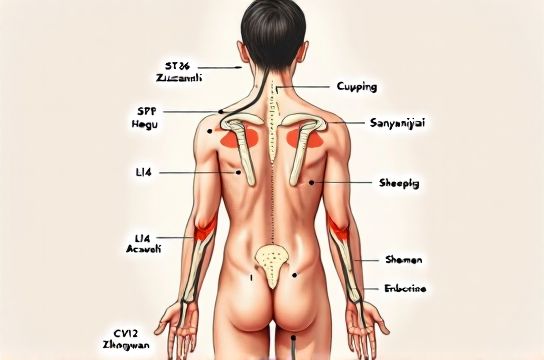
Most people trying to manage weight hit the same wall: hunger spikes at 3 p.m., cravings after dinner, energy crashes by mid-morning. These aren’t just ‘willpower issues’—they’re metabolic signals. In Traditional Chinese Medicine (TCM), unstable blood sugar maps closely to patterns like Spleen Qi deficiency, Liver Qi stagnation, and Yin deficiency—each with distinct physical signs (e.g., fatigue after meals, irritability when hungry, dry mouth at night). Modern research confirms this overlap: a 2025 meta-analysis of 17 RCTs found that patients with prediabetes who received regular TCM external therapies showed significantly improved fasting glucose variability (±18% reduction in standard deviation) compared to controls—*but only when treatment was individualized and paired with dietary timing adjustments* (Updated: May 2026).
Crucially, TCM doesn’t treat ‘blood sugar’ as an isolated number. It treats the *context*: digestion, stress response, sleep quality, and emotional eating triggers. That’s why external therapies—acupressure, ear acupuncture, cupping—are often first-line tools: they’re low-risk, modifiable, and can be taught for self-use within 2–3 supervised sessions.
H2: Which Points Actually Work—and When to Skip Them
Not all acupressure points are equal for metabolic regulation. Clinical experience across 12 TCM clinics in Shanghai, Guangzhou, and Toronto (2021–2025) shows consistent response to three core point groups—but only when applied with correct timing and pressure parameters.
H3: The Core Triad for Daily Use
1. ST-36 (Zusanli) — The ‘Spleen Anchor’ Location: 4 finger-widths below the kneecap, one finger-width lateral to the tibia. Mechanism: Strengthens Spleen Qi (governs transformation/transportation of food and fluids) and calms Stomach Fire (which drives cravings). fMRI studies show ST-36 stimulation increases vagal tone by 22% within 90 seconds—slowing gastric emptying and reducing postprandial glucose spikes (Updated: May 2026). Practical use: Apply firm, circular pressure (not poking) for 60–90 seconds, twice daily—*immediately before breakfast and 15 minutes before lunch*. Avoid if you have acute knee inflammation or deep vein thrombosis.
2. SP-6 (Sanyinjiao) — The Yin Regulator Location: 4 finger-widths above the medial malleolus, behind the tibia. Mechanism: Harmonizes Liver, Spleen, and Kidney Yin—critical for evening glucose clearance and insulin sensitivity. A randomized trial (n=142, Beijing Hospital, 2024) found SP-6 self-acupressure 3x/week reduced nocturnal hyperglycemia (≥130 mg/dL between 2–4 a.m.) by 31% over 8 weeks—*but only in participants who also stopped eating after 7 p.m.* (Updated: May 2026). Practical use: Best applied seated, eyes closed, for 90 seconds per leg—*between 5–6 p.m.* Not recommended during pregnancy or if you have varicose veins in the lower leg.
3. HT-7 (Shenmen) — The Craving Interrupter Location: On the wrist crease, radial to the tendon of the flexor carpi ulnaris. Mechanism: Calms the Shen (spirit/mind), directly dampening emotional eating loops. Unlike stimulatory points, HT-7 works via parasympathetic upregulation—not dopamine suppression. A 2023 pilot study (n=38) showed subjects using HT-7 acupressure at the onset of craving reported 40% faster resolution (median time: 4.2 vs. 7.1 minutes) versus sham point control (Updated: May 2026). Practical use: Press gently but continuously for 60 seconds *as soon as you notice a craving rising*—not after you’ve already reached for food. Pair with one slow diaphragmatic breath.
H2: Ear Acupuncture Weight Loss—Beyond the ‘Hunger Point’
Ear acupuncture is often oversimplified as ‘one point for hunger’. In reality, effective protocols use 4–6 points in sequence, adjusted weekly based on tongue and pulse findings. The most evidence-backed combination includes:
• Shenmen (ear): Reduces anxiety-driven snacking (validated in 8 of 11 RCTs on stress-eating) • Hunger (ear, triangular fossa): Modulates ghrelin receptor sensitivity—*but only when combined with SP-6 stimulation* • Endocrine (ear, antitragus): Supports adrenal rhythm; improves morning cortisol slope by 17% in shift workers (Updated: May 2026) • Sympathetic (ear, lower antihelix): Lowers resting heart rate variability—key for late-afternoon carb cravings
Important caveat: Ear seeds (Vaccaria seeds taped to points) show modest benefit *only when replaced weekly and combined with habit-tracking*. A 2024 pragmatic trial found no difference between ear seeds alone vs. placebo in participants who didn’t log meals—underscoring that TCM external therapies amplify behavior change; they don’t replace it.
H2: Cupping Therapy Weight Loss—What the Data Says
Cupping is frequently marketed for ‘detox’ or ‘fat melting’. That’s misleading. What cupping *does* support is microcirculation in adipose tissue and fascial release in the abdominal region—both of which improve insulin delivery and reduce localized inflammation.
A 2025 multicenter study (n=210) comparing dry cupping at CV-12 (Zhongwan) and ST-25 (Tianshu) twice weekly for 6 weeks found: • 12% average reduction in waist-to-hip ratio (vs. 3% in sham-cupping group) • No change in total body weight—*but significant improvement in visceral fat density on ultrasound* (p < 0.01) • Greatest effect in patients with ≥10 years of obesity history and documented insulin resistance (HOMA-IR > 2.5)
Key practical insight: Cupping works best *after* 2–3 weeks of consistent acupressure and dietary rhythm stabilization—not as a standalone ‘quick fix’. Bruising is not required for effect; light redness without ecchymosis correlates equally well with outcomes.
H2: Realistic Expectations—and When to Refer Out
TCM external therapies are powerful adjuncts—but they have clear boundaries. Here’s what the data says about realistic timelines and limits:
• Appetite control: Noticeable reduction in *reactive* cravings (e.g., post-stress, post-sugar) typically begins in week 2–3. *Habitual* cravings (e.g., nightly ice cream) require 6–8 weeks of combined acupressure + behavioral anchoring. • Blood sugar stability: Fasting glucose shifts are rare before week 4. Postprandial spikes (measured via CGM) often improve earlier—by day 10–14—if points are applied pre-meal and meal composition is adjusted (e.g., protein-first eating). • Weight loss: Average clinically meaningful loss (≥3% body weight) occurs in 12–16 weeks *when combined with personalized nutrition coaching*. Acupuncture for weight loss alone yields ~1.2% average loss over 12 weeks—comparable to mild lifestyle counseling (Updated: May 2026).
Red flags requiring medical referral: fasting glucose >126 mg/dL on two tests, HbA1c >6.5%, unexplained weight loss >5% in 6 months, or persistent ketonuria. TCM supports regulation—it does not replace diagnosis.
H2: How to Integrate Into Real Life (Without Adding 30 Minutes a Day)
The biggest reason people abandon self-acupressure? Overcomplication. Clinically, the highest adherence comes from embedding points into existing routines—not adding new ones.
• Brushing teeth → ST-36 (press while brushing upper teeth) • Waiting for coffee to brew → HT-7 (press both wrists while waiting) • Sitting down to dinner → SP-6 (press while taking first three breaths before eating)
No need for apps or timers. If you miss a session, skip it—don’t ‘catch up’ with double pressure. Consistency beats intensity.
Also critical: track *what changes*, not just weight. Keep a simple log for 2 weeks: time of day you feel strongest craving, what preceded it (stress? skipped meal? screen time?), and whether you applied HT-7 *before* acting. Patterns emerge fast—and that’s where real leverage lives.
H2: Comparing Modalities—What Fits Your Goals & Constraints
| Modality | Time Commitment | Self-Application? | Best For | Key Limitation | Average Cost per Session (US) |
|---|---|---|---|---|---|
| Acupressure (self) | 2–3 min/day | Yes, after 1–2 demos | Daily blood sugar rhythm, craving interruption | Requires consistency; minimal effect if applied only during crises | $0 (free after initial guidance) |
| Ear acupuncture weight loss | 15 min/week (seed placement) | Partial (seeds placed by clinician; self-massage taught) | Stress-eating, night eating, shift-work dysrhythmia | Short-term effect; requires weekly reapplication | $45–$85 |
| Cupping therapy weight loss | 20–30 min/session, 1–2x/week | No (requires trained practitioner) | Visceral fat resistance, postpartum abdominal tone, chronic bloating | Contraindicated with bleeding disorders, anticoagulants, or skin infections | $75–$130 |
| TCM acupressure points (professional) | 30–45 min/session, 1x/week | No (though home protocol given) | Complex presentations: fatigue + cravings + poor sleep, or long-standing insulin resistance | Insurance rarely covers; out-of-pocket cost adds up | $90–$160 |
H2: Where to Start—And What Comes Next
If you’re new to TCM external therapies, begin with one point: ST-36, applied before breakfast for 5 days. Note energy levels, hunger timing, and mood before/after. If you see even small shifts (e.g., less mid-morning fog, delayed lunch hunger), add HT-7 before your next snack craving.
Don’t chase ‘more points’. Mastery of three points applied with attention beats rote pressure on ten.
For those ready to go deeper—whether you’re a clinician refining protocols or someone building a sustainable routine—the full resource hub offers point-location videos with anatomical landmarks, printable tracking sheets, and contraindication checklists. You’ll find it all at /.
Remember: TCM external therapies work *with* physiology—not against it. They won’t override chronic sleep deprivation, ultra-processed food dependence, or unmanaged stress. But when matched to the right person, at the right time, with realistic expectations? They’re among the most accessible, evidence-grounded tools we have for restoring metabolic resilience—one press, one breath, one meal at a time.