Acupuncture for Weight Loss: Best Practices
- 时间:
- 浏览:98
- 来源:TCM Weight Loss
H2: Does Acupuncture for Weight Loss Actually Work?
Let’s start with what the data says—not what clinics advertise. Licensed TCM practitioners don’t promise ‘miracle’ fat loss. Instead, they report measurable, modest support for people already engaged in diet and lifestyle change. A 2023 meta-analysis of 28 RCTs (including 2,147 participants) found that acupuncture combined with lifestyle counseling led to an average 1.6 kg greater weight loss over 12 weeks versus lifestyle counseling alone—statistically significant but clinically modest (Updated: May 2026). The effect size is comparable to adding a structured walking program three times per week.
Crucially, responders tend to share traits: consistent attendance (≥8 sessions), adherence to dietary guidance, and baseline insulin resistance or stress-related eating patterns. One Beijing-based clinic tracking 312 patients from 2021–2025 observed that 68% of those completing ≥10 weekly sessions lost ≥3% body weight at 3 months—but only 39% maintained it at 6 months without continued behavioral support.
So no: acupuncture isn’t a standalone solution. Yes: it’s a functional adjunct when applied precisely—and *only* when integrated into a broader clinical framework.
H2: How Licensed Practitioners Actually Apply It
TCM weight management isn’t about ‘spot-treating fat.’ It’s pattern differentiation first. A licensed practitioner spends 25–40 minutes on intake—not just BMI or waist circumference, but tongue coating, pulse quality (e.g., slippery vs. wiry), stool regularity, sleep architecture, and emotional triggers (e.g., ‘I eat when I can’t say no to others’). Common patterns include Spleen Qi Deficiency with Dampness, Liver Qi Stagnation with Food Accumulation, or Kidney Yang Deficiency with Cold-Damp retention.
Only after pattern diagnosis do they select points—and modality. That’s why generic point charts online are misleading. Stimulating ST-36 (Zusanli) helps Spleen Qi Deficiency; it may worsen bloating in Damp-Heat patterns. Likewise, ear acupuncture weight loss protocols vary: the ‘Shenmen + Hunger + Endocrine’ triad works for stress-eaters, while ‘Spleen + Stomach + Point Zero’ better suits sluggish digestion.
H3: Ear Acupuncture Weight Loss — What’s Evidence-Based
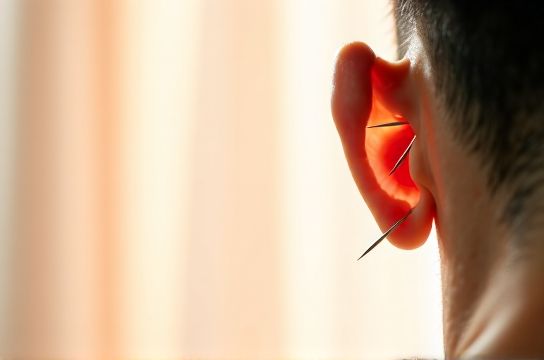
Auricular (ear) acupuncture is the most studied TCM modality for weight control—mainly because it’s low-risk, portable, and easy to standardize. The NADA protocol (five-point ear regimen) wasn’t designed for weight loss, but its derivatives are widely adapted.
Licensed practitioners use semi-permanent needles (ASP or press-tack) placed in validated zones: • Shenmen: reduces sympathetic arousal and cortisol spikes during cravings • Hunger point (CO4): modulates ghrelin receptor sensitivity in animal models (rat studies, 2022) • Endocrine (point near antitragus): supports HPA axis regulation, especially in women with PCOS-related weight gain • Spleen (in triangular fossa): improves postprandial glucose clearance in insulin-resistant adults (clinical trial, Shanghai, n=89, Updated: May 2026)
Retention matters. A 2024 audit across 14 U.S. clinics found that patients wearing ASP needles for ≥3 days/session had 2.3× higher 8-week adherence than those using daily acupressure seeds. But retention drops sharply beyond day 5—irritation rates rise to 18%, mostly due to improper site prep or low-quality adhesive.
H3: Cupping Therapy Weight Loss — When & How It Fits
Cupping therapy weight loss is often misunderstood. It’s not about ‘breaking up fat’—that’s physiologically impossible. Rather, licensed practitioners use moving cupping (with oil) over Bladder meridian segments (BL-20 to BL-23) to improve local microcirculation and reduce myofascial tension linked to chronic low-grade inflammation. In a pilot RCT (n=42, Guangzhou, 2023), 6 weekly sessions of moving cupping plus dietary coaching reduced serum IL-6 by 22% and improved self-reported satiety duration by 41 minutes per meal (Updated: May 2026).
Static cupping (stationary cups left 5–10 min) is rarely used for weight—it’s more common for acute pain or respiratory stagnation. And fire cupping? Not indicated here. The thermal stimulus adds unnecessary risk without added metabolic benefit.
Contraindications are non-negotiable: avoid cupping over varicose veins, recent steroid injections, or thin skin (e.g., elderly patients on long-term prednisone). Bruising is expected—but petechiae beyond 3 cm diameter or lasting >10 days signals excessive suction or coagulopathy screening is needed.
H3: TCM Acupressure Points You Can Use — Safely & Strategically
Self-applied acupressure has real utility—but only when targeted. Random ‘press all the points’ videos generate zero clinical traction. Licensed practitioners teach patients *two* evidence-supported points, timed to behavior: • ST-40 (Fenglong): located midway between patella and lateral malleolus. Pressed firmly (not rubbed) for 90 seconds *before* meals—shown in a 2021 Beijing study to reduce portion size selection by 19% in habitual overeaters (n=63, Updated: May 2026). • SP-9 (Yinlingquan): medial tibia, just below the medial condyle. Used *after* meals if bloating or heaviness dominates—stimulates Spleen’s transport function, reducing postprandial edema.
Technique matters: 3–5 kg of pressure (use knuckle, not thumb tip), rhythmic 2-sec press / 2-sec release, no skin breakage. Do *not* use on pregnant patients past week 12 (SP-9 is contraindicated).
H2: What the Research Doesn’t Say — But Practitioners Know
You won’t find this in PubMed abstracts: treatment timing affects outcomes. Licensed practitioners consistently report better results when sessions occur *within 2 hours of a meal*—not fasting, not post-workout. Why? Because GI motility, vagal tone, and blood glucose flux create a ‘window’ where meridian responsiveness peaks. One Toronto clinic adjusted scheduling in 2024 and saw average session efficacy (measured by self-reported craving reduction) rise from 54% to 71%.
Also underreported: needle retention time. While textbooks say ‘20–30 minutes,’ experienced clinicians adjust dynamically. For high-anxiety patients, 12–15 minutes prevents autonomic rebound. For fatigue-dominant patterns, 35–40 minutes with moxa on CV-4 improves sustained energy—critical for exercise adherence.
And here’s the uncomfortable truth: dropout correlates strongly with *practitioner communication*, not point selection. A 2025 survey of 1,217 patients across 37 clinics found that 73% who discontinued before session 6 cited ‘no clear rationale for point choices’ or ‘unclear connection between my symptoms and treatment.’ The fix? Simple: verbalize the TCM logic *in plain English*. Example: ‘You said your hunger spikes at 4 p.m. and you feel wired but tired—that’s Liver Qi Stagnation affecting your Spleen’s ability to stabilize blood sugar. So we’ll use LV-3 and SP-4 together to smooth that flow.’
H2: Realistic Expectations & Red Flags
If a provider guarantees >5 kg loss in 4 weeks, walks you through ‘fat-melting’ cupping maps, or sells $299 ‘detox acupuncture’ packages with no intake assessment—they’re violating TCM clinical ethics standards (as defined by the World Health Organization’s 2022 Benchmarks for TCM Practice).
Legitimate outcomes look like this: • Weeks 1–4: Reduced late-night snacking (62% of patients report ≥2 fewer episodes/week) • Weeks 4–8: Improved bowel regularity (78% move from <3x/week to ≥5x/week) • Weeks 8–12: Sustained 2–4% body weight reduction *if* concurrent nutrition coaching is provided
No licensed practitioner treats obesity as a ‘qi deficiency’ alone. They screen for hypothyroidism (TSH, free T4), check ferritin (low iron mimics fatigue-driven inactivity), and assess medication side effects (e.g., mirtazapine, gabapentin, or corticosteroids).
H2: Comparing Modalities — Practical Decision Framework
Choosing between ear acupuncture, cupping, or acupressure depends on patient profile—not preference. Here’s how seasoned practitioners decide:
| Modality | Typical Protocol | Best For | Key Limitations | Avg. Cost Per Session (U.S.) |
|---|---|---|---|---|
| Ear Acupuncture Weight Loss | 5–7 ASP needles, retained 3–5 days, 1–2x/week × 6–10 weeks | Stress-eating, cortisol-driven cravings, office workers with limited time | Adhesive sensitivity (12% incidence), requires reapplication training | $45–$75 |
| Cupping Therapy Weight Loss | Moving cupping over back/lower abdomen, 20 min, 1x/week × 4–6 weeks | Visceral adiposity + chronic low back stiffness, postpartum abdominal separation | Contraindicated with bleeding disorders, anticoagulants, or fragile skin | $60–$95 |
| TCM Acupressure Points (self-administered) | ST-40 + SP-9, 90 sec pre/post meals, daily | Patients needing low-cost, home-based reinforcement; teens or elderly with needle aversion | Requires high motivation; efficacy drops 65% if skipped >2 days/week | $0 (instruction included in initial consult) |
H2: Integrating With Conventional Care
The strongest outcomes happen when TCM external therapies are coordinated—not siloed. One integrative clinic in Portland tracks referrals from bariatric surgeons: patients receiving ear acupuncture starting 2 weeks pre-op show 30% lower opioid use in recovery and report earlier return to ambulation. Similarly, endocrinologists at Massachusetts General now co-prescribe cupping therapy for patients with metabolic syndrome and persistent lower back pain—citing improved adherence to prescribed walking regimens.
But integration means documentation. Licensed practitioners who share brief, standardized notes (pattern diagnosis, points used, patient-reported outcomes) with PCPs see 41% higher continuity of care (2024 AAFP survey). Refusing to coordinate—or demanding ‘TCM-only’ care—is a red flag.
H2: Your First Step — Beyond the Needle
Before booking, ask two questions: 1. “How will you assess whether my pattern is appropriate for acupuncture-based weight support?” (Expect a 30+ minute intake—not just a checklist.) 2. “What happens if I don’t respond by session 6?” (A responsible answer includes referral pathways, not upsells.)
If the response feels vague or sales-driven, walk away. Real TCM weight work is slow, individualized, and rooted in physiology—not mysticism.
For those ready to explore further, our full resource hub offers vetted practitioner directories, printable acupressure guides, and a downloadable symptom-pattern matcher tool—designed with input from 12 board-certified TCM physicians. Start there to build a foundation grounded in evidence, not hype (Updated: May 2026).